Salt water is harder on an outboard than fresh water, full stop. If you're running out of Key West, Stock Island, or anywhere in the Lower Keys, the manufacturer's "recommended" service interval is really a ceiling — most boats here need attention sooner, not later.
How often should you flush and inspect after a saltwater trip?
Flush the engine with fresh water after every trip you run in salt water, no exceptions. Salt residue left in the cooling passages accelerates corrosion and can clog passages over time, which is one of the more common causes of overheating we diagnose dockside.
If your boat has a built-in flush port, use it every time you trailer or dock the boat. If it doesn't, muffs and a garden hose take two minutes and save you a much bigger bill later.
What does the 100-hour service actually cover?
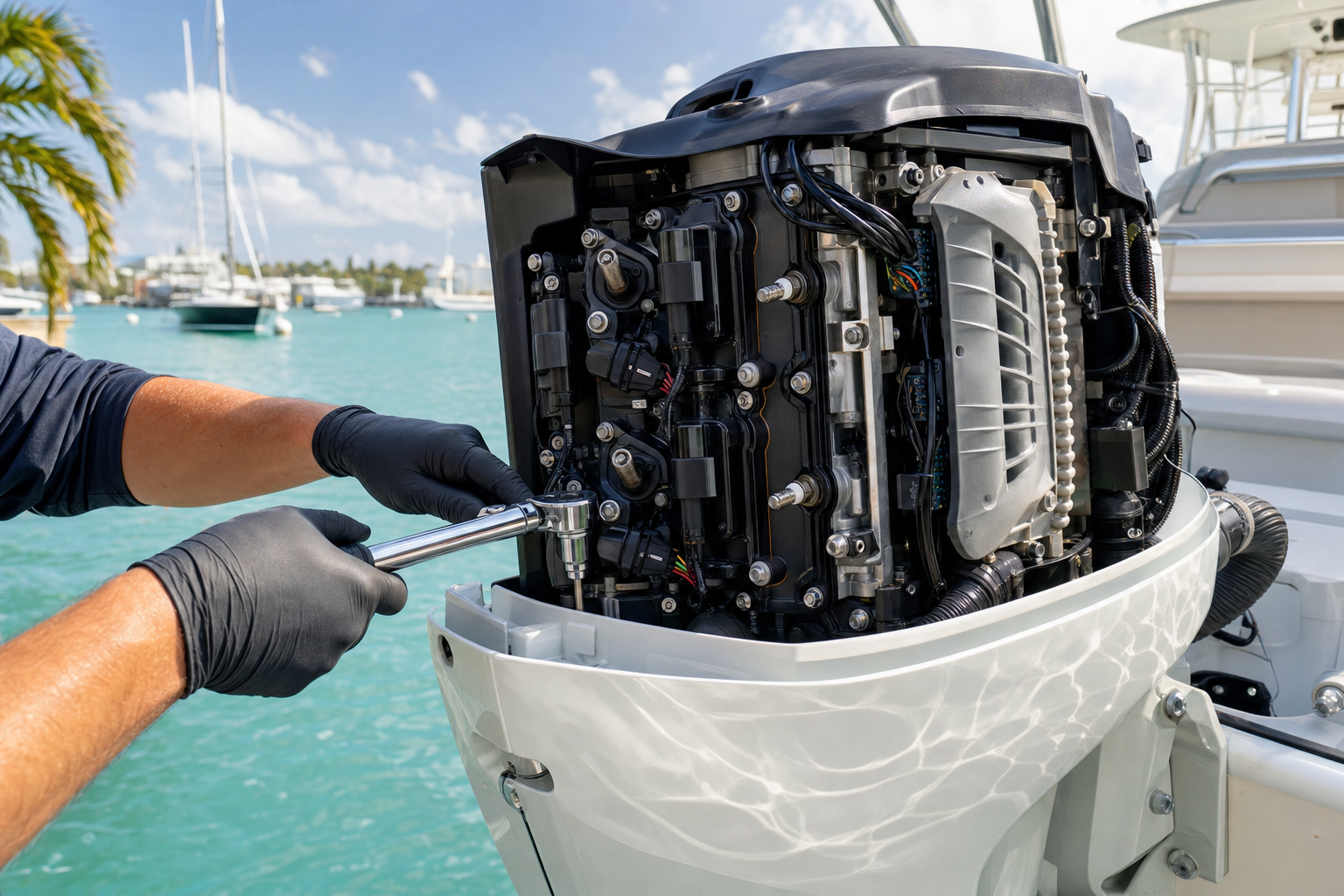
A 100-hour (or annual, whichever comes first) service on a Mercury outboard typically covers the water pump impeller, gear lube, fuel filters, spark plugs, and anodes — the parts that wear fastest and cause the most trouble when neglected.
In salt water, we push customers to treat 100 hours as an outer limit, not a target. A boat that sits at a dock between short runs — common in the Keys — often needs the impeller and anodes checked before it hits 100 hours, because time and salt exposure matter as much as engine hours.
What does the 300-hour service add?
The 300-hour service is the deeper pass: full fluid changes, belt inspection, thermostat check, and a complete inspection of the fuel and cooling systems on top of everything covered at 100 hours. This is also when we typically pull the lower unit for a closer look at the gear case and seals.
How often do anodes need to be checked in the Keys?
Check sacrificial anodes at every service interval, and more often if you keep the boat in a marina slip with stray electrical current in the water — a known accelerant for galvanic corrosion. A worn-down anode isn't cosmetic; it's the part of your boat's electrical/galvanic protection system that's supposed to corrode instead of your outboard's aluminum housing.
If an anode looks more than half consumed, replace it. Waiting until it's gone means your engine's metal starts taking the damage instead.
Does a boat that sits more (vs. runs more) need different service?
Yes. A boat that sits at the dock for weeks between short runs deals with condensation in the fuel system, stale fuel, and corrosion that builds even when the engine isn't running — while a boat run hard and rinsed properly can sometimes go longer between services. Hours on the clock only tell half the story in a saltwater environment; how the boat is used and stored matters just as much.
What should Key West boat owners watch for between services?
Between scheduled services, keep an eye on:
- Starting behavior — any new hesitation, cranking longer than normal, or rough idle
- Corrosion at battery terminals and grounding points — white or green buildup means it's already working
- Overheating alarms or a weak telltale (pee stream) — often the first sign of a clogged water pump or cooling passage
- Trim/tilt sluggishness — hydraulic and electrical components both take a beating from salt air
Catching these early is the difference between a dockside fix and a haul-out.
Get a service schedule built for your boat, not a generic chart
Every boat's real-world service interval depends on how it's used, how it's stored, and what engine's on the transom. Our Mercury Marine Certified technician can build a schedule specific to your boat and get the work done at your dock — see Mercury Diagnostics & Repair for the full scope of what a scheduled visit covers, or check Marine Electrical Services if corrosion has reached your wiring, not just your engine.
Call or text (305) 832-1206, email info@3marinekw.com, or book online.
---