Salt air doesn't just corrode what gets wet — it corrodes what's just nearby. If your boat lives outside in the Keys year-round, its electrical system is fighting a slower, quieter battle than its engine, and it usually loses first at the connections nobody's looking at.
Why is corrosion worse on boats in the Florida Keys specifically?
Constant humidity, airborne salt, and warm temperatures year-round create ideal conditions for corrosion — there's no cold, dry winter to slow it down like boats get in other parts of the country. A connection that might corrode slowly over several seasons up north can degrade in a single Keys summer.
What's the difference between galvanic and electrolytic corrosion?
Galvanic corrosion happens naturally when two different metals are connected in salt water, which acts as an electrolyte — one metal (usually the anode) sacrifices itself to protect the other. Electrolytic corrosion is different: it's caused by stray electrical current, often from a wiring fault, bad ground, or another boat's faulty shore power connection in the same marina, and it can eat through metal far faster than galvanic corrosion alone.
If your anodes are disappearing unusually fast, that's often a sign of stray current in the marina, not just normal galvanic wear — and it's worth a proper electrical diagnostic rather than just buying more anodes.
What does a sacrificial anode actually do?
An anode is designed to corrode instead of your boat's more expensive metal components — the outdrive, through-hull fittings, and engine housing. It's not decorative and it's not optional; a consumed anode means your boat's actual hardware is now taking the corrosion instead.
Where does corrosion hit a boat's wiring first?
The first failures usually show up at:
- Battery terminals and ground straps — the most common point we find corrosion during a service call
- Connector and terminal crimps that weren't properly sealed when installed
- Bilge pump and float switch wiring, which sits in one of the wettest spots on the boat
- Navigation light sockets and connectors, exposed to spray and rain constantly
A connection doesn't have to be submerged to corrode — humidity and salt air alone will do it over time.
What are the warning signs of electrical corrosion before something fails completely?
Watch for a bilge pump that runs intermittently or not at all, navigation lights that flicker or dim, a charging system that seems to undercharge the battery, or breakers that trip for no obvious reason. These are often corrosion at a connection point, not a failed component — which means a proper diagnostic can often fix it without replacing expensive parts.
How should marine wiring be installed to resist Keys conditions?
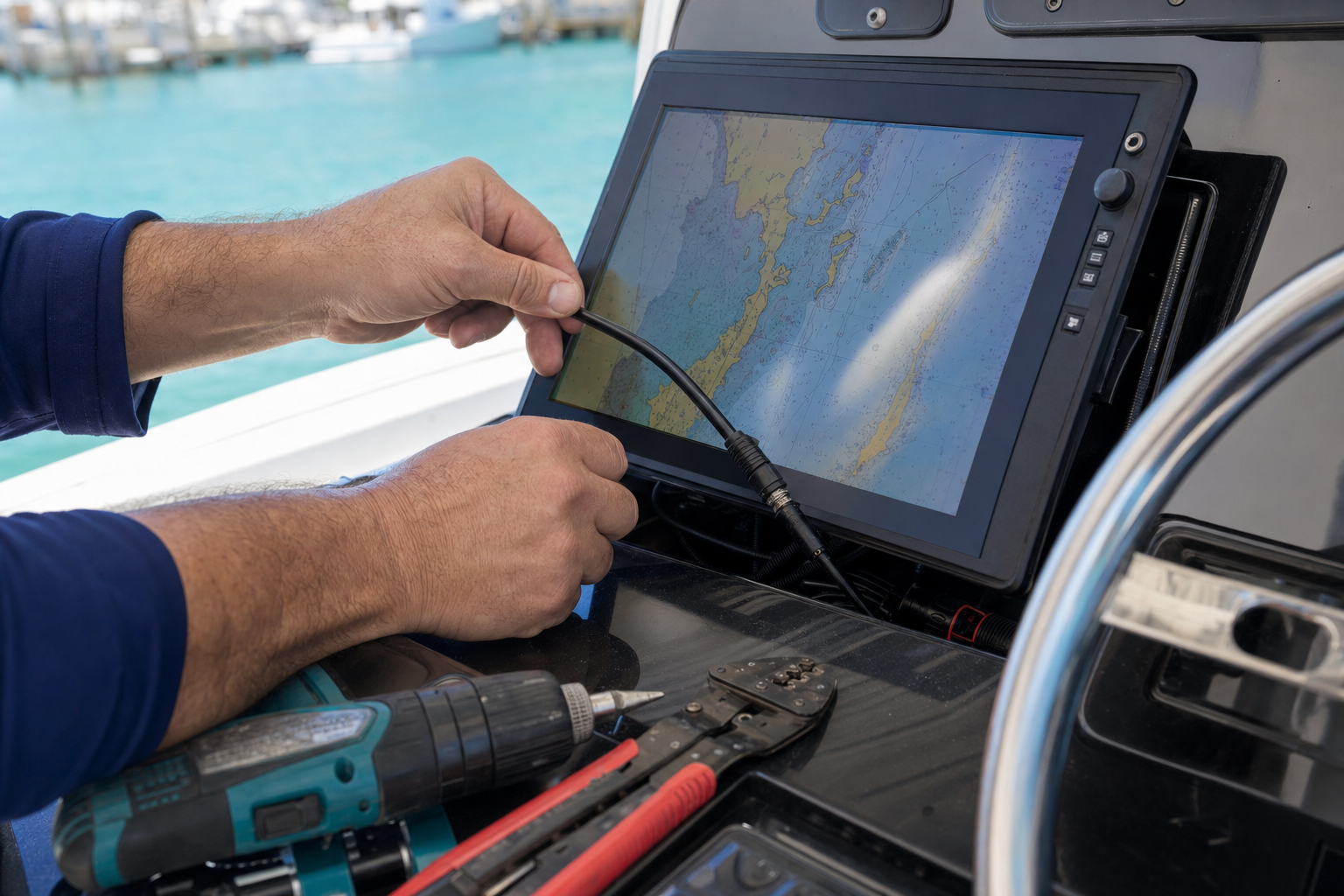
ABYC standards call for tinned marine-grade wire, properly sealed heat-shrink connectors, and secure strain relief — not standard automotive wire and butt connectors, which corrode fast in a marine environment. Our lead technician is an ABYC Certified Master Technician and NMEA Certified Installer, meaning any wiring or electronics work is done to the standard built for salt air, not shortcuts that fail in a season.
Can corrosion damage be prevented, or only slowed?
Corrosion in a saltwater environment can't be stopped entirely, but it can be slowed significantly with proper anodes, marine-grade wiring and connectors, regular fresh-water rinsing of electrical compartments where practical, and catching early warning signs before they become full failures. Boats maintained this way routinely outlast boats that aren't — the difference shows up in the electrical bill, not just the paint.
Get your electrical system checked at your dock
Corrosion problems rarely announce themselves clearly — a flickering light or an intermittent pump is often the first visible sign of something bigger. See Marine Electrical Services for the full scope of what we handle, from battery banks and charging systems to full rewiring and electronics installation.
Call or text (305) 832-1206, email info@3marinekw.com, or book online.
---